






If you’re in staffing and recruiting, the writing on the wall is clear: AI is going to change how we work in this industry. The big question is, where do you start?
Because of challenges in data preparedness, disjointed systems, or a lack of concrete process surrounding AI, firms may be struggling to create a clear plan of attack. Staffing agencies know they should be using AI and automation, but aren’t exactly sure how.
Leveraging generative AI to create job descriptions is one of the most practical entry points into AI for staffing agencies. It offers immediate benefits in recruiter productivity, speed-to-placement, brand consistency, and data security. Organizations are already recognizing that value; according to SHRM, 66% of businesses using AI in recruiting are already using it to write job descriptions.
In this article we’ll look at why job descriptions are such a prime deployment point for generative AI, the benefits of this use case, and how the technology is changing how recruiters operate.
The Competitive Advantage of AI-Powered Job Descriptions
If you’re a recruiter, you’re acutely aware that every minute a job order is open is critical. In temporary staffing, every hour between receiving a job order and publishing a posting creates an opportunity for competitors to engage candidates first.
Say a job order comes in at 9am for 15 warehouse workers, five of which require forklift certification, all for roles that are set to start in 24 hours.
In the past, this order coming across the recruiter desk would mean a recruiter pulling an old job description, copying and pasting it, adjusting relevant information such as site location, pay, assignment duration, and more, and then publishing the listings to various job boards.
Not a heavy lift, but a task that requires detail orientation; maybe it takes a recruiter 30 minutes to complete. Now multiply this task by 5 orders that come in in a day. This could mean 2-3 hours of a recruiter’s time spent manually entering information, and the end result is nothing more than a generic, templatized description that lacks anything optimized for the role itself or the platforms on which it’s appearing.
Now contrast with the process of an AI-produced job description.
That same order comes in at 9am. The recruiter has a generative AI integration within their ATS where they can pull all relevant information into a prompt to create job descriptions for 15 unique roles. The prompts are generated in a matter of seconds, populated with all details specific to the client.
These tools can also naturally incorporate role-specific keywords, certifications, and industry terminology that improve search relevance on job boards, helping listings surface for the candidates most likely to apply.
The recruiter is able to take these optimized job postings and publish them to job boards in a fraction of the time, getting their listings out before their competitors.
It seems like a minor contrast; a matter of minutes. But in a market as tight as staffing, those minutes are critical to winning the bid.
Research also suggests that early visibility matters. Job post discoverability is highest when listings are fresh and optimized for job boards, so getting tailored listings up as quickly as orders come in could make all the difference for staffing agencies.
Better Job Descriptions Attract Better Candidates
Leveraging AI for descriptions also means including levels of detail that are typically absent from templatized job listings.
Without much additional effort, recruiters are able to add elements like clear delineations of responsibility, scheduling notes, shift differentials, client culture, etc.
Including these details gives talent an opportunity to better set expectations for the role. By having a full understanding of what the position entails, candidates can make a more informed decision on whether they would be a right fit or not.
Creating this foundation of understanding, recruiters are more likely to build a candidate pool of interested and informed workers who already get the requirements and demands of the position.
Using AI Job Descriptions to Preserve Brand Credibility
Job descriptions are a key point of engagement between talent and a staffing firm. If listings are inaccurate, contain spelling or grammatical errors, or lack personality, they could reflect poorly on the agency.
The issue with manually created job descriptions is that they require high attention to detail. When a recruiter is building these listings at scale, mistakes happen. Even the best, most meticulous recruiters can slip up.
It only takes one error in pay rate not matching the job order, or a location that sends talent to the wrong job site, and it can erode a client’s confidence in your professionalism or attention to detail.
In addition to brand credibility, it also creates a consistent brand voice. Rather than job descriptions being the work of individual recruiters, if all recruiters are using the same generative AI system, it builds job description consistency no matter which recruiter is posting it.
The Importance of AI Integration for Job Descriptions Within Your ATS
There are countless generative AI tools on the market, many of which deliver a similar level of sophistication when it comes to their ability to write a job description based on a detailed prompt.
Where they fall short is on two key fronts: access to a set of reliable data to pull from, and security.
Generating job descriptions requires a certain level of specificity not available within common generative AI tools. If you’re looking to include jobsite-specific information, you may not get desired results from publicly available AI tools that scan the internet for information.
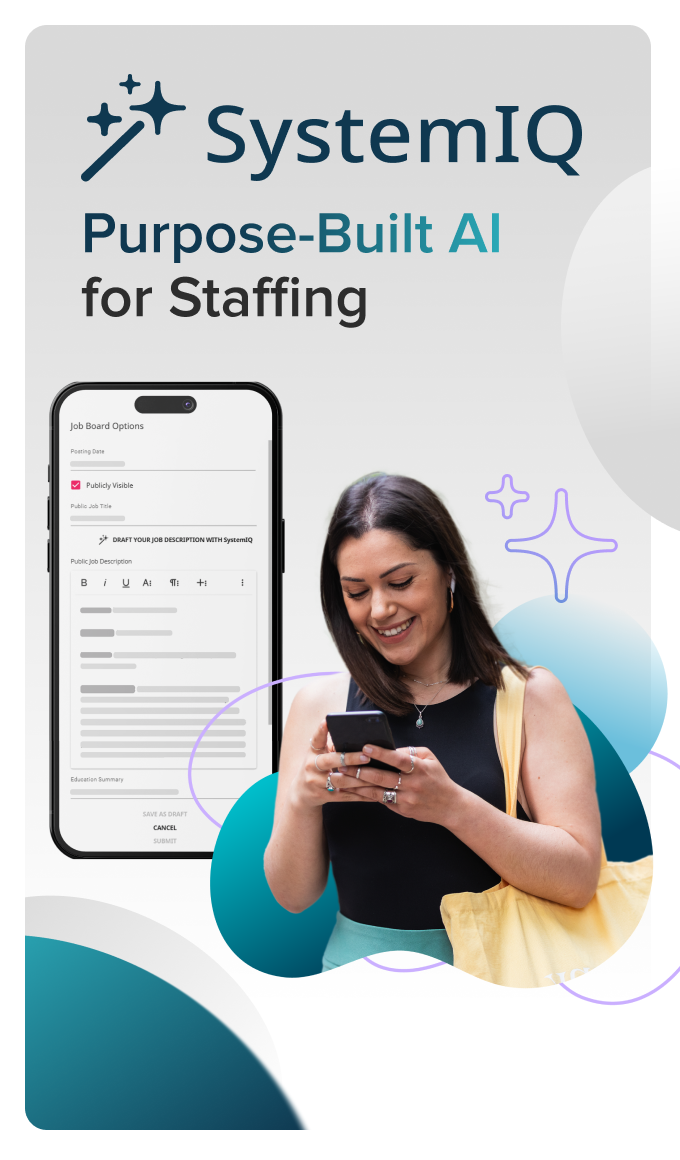
Within an integrated AI tool, like TempWorks SystemIQ, a recruiter will be able to pull from a customer’s location data to create job descriptions with accurate information associated with their record within the ATS. But that’s not all; ATS-integrated AI tools can pull client name, facility type, shift, pay rate, assignment length, required certifications, PPE requirements, and so much more – information that would be made generic in a posting created through a standalone AI tool.
On the security side, leveraging public AI tools usually means copying data from within your ATS and putting it into a system whose security can’t be guaranteed. Sharing sensitive information might break confidentiality agreements or could expose a client to the risks of a data breach.
Giving Recruiters Time Back to Recruit
There is no silver bullet when it comes to AI for staffing agencies. Without sound processes and data practices, investment in AI may not yield the results that firms are hoping for.
Generative AI for job descriptions, particularly tools integrated directly to an agency’s ATS can cut hours of meticulous manual labor off a recruiter’s plate, giving them time to focus on the person-to-person engagement that drives growth in staffing.
For agencies looking for the right entry point into AI, job descriptions are the perfect first step.
For more information on integrated generative AI for staffing professionals, reach out to our team to schedule a demo today.