






Whether the staffing industry is willing to admit it or not, we’re firmly in the age of AI. Investment in the technology is at an all-time high, and adoption rates are transforming operations across staffing firms of all sizes. According to Staffing Hub, 61% of agencies were leveraging some form of AI in 2025 (up from 46% in 2024).
AI seems inevitable; not a matter of if it’s integrated into staffing operations but when and how. Pressure to adopt new systems may lead firms to jump into the deep end without having a plan on how they’ll leverage these tools, however, which can cause operational disruptions and wasted investment.
Not understanding the different roles and capabilities of AI can misalign expectations with reality. AI is not a “silver bullet.” Instead, it’s a tool in your toolkit.
Let’s break down what “AI for staffing agencies” actually means; the different forms it can take, what it can and can’t do, what it needs to operate successfully, and how you can get started on your AI journey.
What Do We Mean By “AI for Staffing Agencies”?
Taking a practical approach, it’s best to define AI by its intended outcomes for staffing agencies. These include better, faster placements of talent in open roles, deeper insights and performance tracking, and (perhaps most importantly) less time spent on low-level manual tasks, freeing up recruiters, salespeople, and administrators to focus on the human aspect of staffing.
AI for staffing takes on multiple forms that can show up at different points in the talent journey. The three main modes of AI are generative, directive, and agentic.
- Generative AI is an engine that creates content based on a prompt or directive (think ChatGPT, Claude, etc).
- Directive AI is an intelligent layer within your existing technology that can be used to analyze data and uncover insights.
- Agentic AI has the ability to act as an agent on your behalf. In staffing, agentic AI models act independently (with some guidance), taking on the form of recruiters, salespeople, administrators, and more.
Now that we know the different forms AI can take, we can look at how they accomplish those ideal outcomes at different points in the staffing lifecycle.
How AI Can Create Better, Faster Placements
Creating faster placements of the right talent is a major advantage that AI can accomplish because it’s the most directly tied to revenue; an outcome that’s particularly important in lean job markets.
One of the main ways AI enables better, faster placements is through more intelligent candidate matching. Essentially, AI can process language better, using contextual and semantic search to identify candidates automatically, rather than qualified, ideal candidates falling through the cracks because their qualifications within the ATS aren’t the exact language a recruiter is searching.
Next, using the directive model we mentioned earlier, AI can work within a staffing firm’s ATS to create more usable, searchable data. By deploying a directive AI layer into the system, AI has the ability to parse and standardize resumes and onboarding documentation to create a richer, more usable database. When job orders come in, recruiters are better able to find the right candidate based on current, accurate data.
AI can help with speed to placement in a number of ways, reducing time to fill by as much as 60%. AI candidate matching can take job order data and evaluate hundreds of applicants based on the parameters of the job description to shortlist candidates; a process that could take hours for a recruiter to do manually. When candidates are moved through the funnel, AI can streamline communications to facilitate onboarding and getting candidates work-ready on their pace, rather than playing phone tag with the staffing firm to get necessary documentation in the system.
Lastly, AI can keep candidates engaged before, during, and after placements so they’re kept on the radar for the next assignment. Automated messaging ensures consistent communication, so when an open job order comes in, a candidate is already primed and ready in the system, saving time and money on sourcing net-new hires for every open role.
How AI Can Be Leveraged to Make Better Business Decisions
One of AI’s strongest suits is making data actionable. We just looked at how it can be leveraged for operational efficiency, now let’s talk about business intelligence.
AI can assess the fill probability of open orders based on historical data. By understanding how similar roles filled in the past, current candidate pipeline depth, time-of-year patterns, and client history, it allows recruiters and managers to prioritize their efforts toward orders that are most likely to close, and flag orders at risk before they become obsolete.
Predictive Analytics for Staffing Agencies
Within a CRM, firms can also leverage AI to get a better picture of overall business and market health. AI can analyze historical billing data, industry hiring trends, and seasonal patterns to help agencies anticipate demand surges in specific verticals or regions. It can also track bill rates to ensure they don’t drift below target numbers and provide more robust forecasting data to help firms stay on an ideal growth trajectory.
An estimated 70% of top staffing firms are already using AI-driven predictive analytics to guide their decision making, so the proof is in the pudding.
And, much like with talent redeployment, AI within a CRM can help promote client engagement by automating outreach or notifying sales teams to be proactive with clients who haven’t been engaged in a certain period of time.
How AI Can Save Time
All of the applications for AI we’ve mentioned are game-changing; but they may be advanced (and require outsize investment) for many agencies; particularly those with fewer than 50 employees.
As an entry point to the capabilities of AI, let’s talk about the time (and cost) savings of generative AI and automation.
Staffing is a people business; the best recruiters stand out through their ability to foster relationships with clients and talent to understand need and source the right employee to fill that need. Too much of a recruiter’s workday is spent on manual tasks that take them away from focusing on the people side of their skill set.
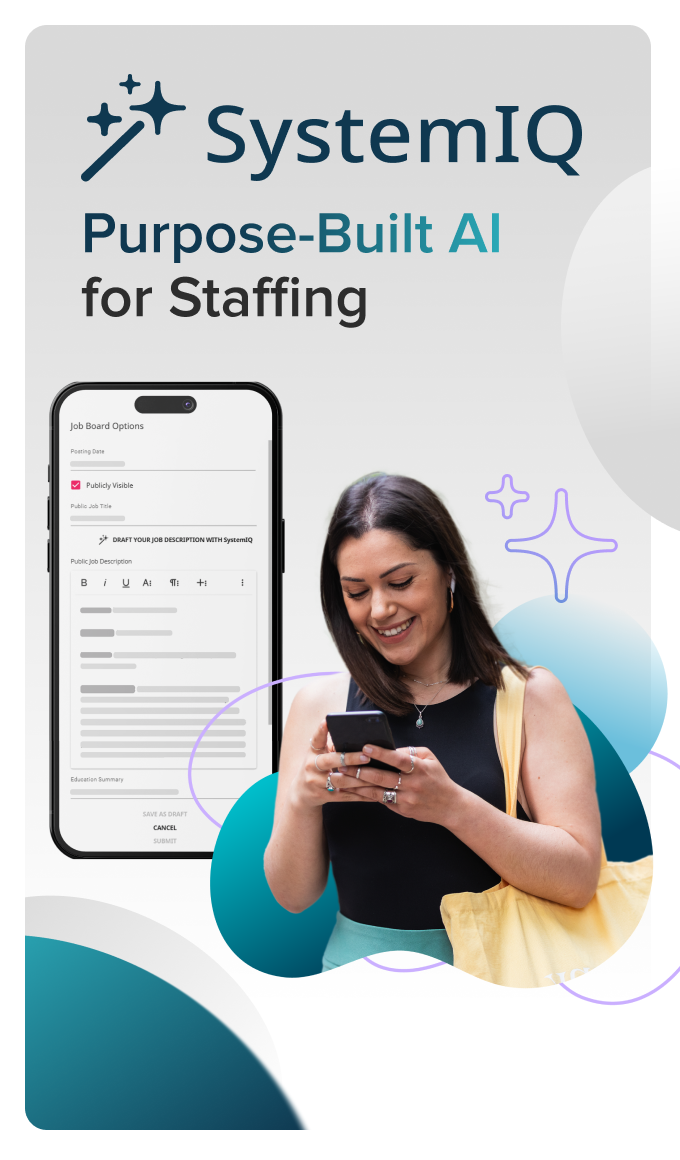
AI can be leveraged to automate nearly every manual aspect of the recruitment workflow. Anything that requires content creation – job descriptions, talent or client outreach including candidate summaries, documentation requests, assignment information and more – can be generated directly within your staffing software in a matter of seconds.
Learn more about SystemIQ, TempWorks native generative AI tool for staffing.
What’s more, this content is created by pulling relevant information from your database; this ensures not only accuracy, but enables the agency to keep sensitive candidate and client data within their system of record and not exposing it to external tools like ChatGPT or the open internet.
AI can also provide front-line communication to take the burden off of administrators. Again, pulling from your database’s information, automated messaging and new generations of natural-language processing chatbots can provide talent with everything from detailed assignment information, request missing documents, handle payroll questions, or even manage call-out requests.
There are countless other time-saving applications for AI and automation – from scheduling and onboarding to flagging payroll errors and candidate matching. All of these benefits give staffing agencies the time back to focus on people, building relationships that making firms thrive.
What AI Can’t Do In Staffing (And Shouldn’t)
The capabilities of AI are exciting and seemingly endless, but the important thing to remember is that it’s a tool like any other. When it’s leveraged correctly, it frees staffing teams from the manual tasks that distract them from making the connections that drive business growth.
It also equips them with the competitive tools they need to win; uncovering the best candidates, engaging them faster, and identifying every opportunity to excel in a firm’s region or vertical.
AI also can’t do it alone. Before any of these tools can be used to their fullest potential, it requires sound data inputs, accurate and organized information to pull from, and a firm set of standard operating procedures (SOP) that guide your team’s use of the tools.
When executed successfully, AI can truly be a gamechanger. But without a plan of action and stated goals, it can also be a major investment that fails to live up to its promise.
Where to Start With AI in Staffing
In the end, “AI for staffing” isn’t one thing. It’s a set of tools that can help staffing firms (and candidates) at every step of the journey. When deployed thoughtfully and intentionally, they can create new efficiencies, cost savings, and free recruiters and other team members up to focus on high-value touchpoints and personal connections that give firms a competitive edge.
Without a plan of attack, however, “AI for staffing” can mean wasted investment, unreliable results, or tools that can’t be utilized to their fullest capacity.
Getting started with AI doesn’t need to be an all or nothing endeavor. Start small with the highest friction points within your workflow, measure the success of your deployment, and build from there.
And, as always, you don’t need to go into this alone. If you’re interested in AI but aren’t sure where to start, reach out to the team at TempWorks to find out more!